Prompt Engineering for Marketers: The Simple Guide to Getting Better AI Results

Updated: Oct 24, 2025
Twenty years ago, at companies like Nestlé, marketers spent countless hours perfecting one critical skill: writing briefs. These documents told agencies, retail teams, and partners exactly what needed to be done. Workshops and training sessions were dedicated to this craft because a good brief meant successful campaigns, while a poor brief wasted everyone's time.
Today, that same skill has evolved into something equally important: prompt engineering. If you want AI to work for you instead of frustrating you, learning how to write effective prompts is no longer optional it's essential.

Mastering prompt engineering: The new essential skill for modern marketers
What Is a Prompt? (It's Simpler Than You Think)
A prompt is simply the instruction or question you give to an AI tool to get a response. Think of it like:
A brief to an agency – You're telling the AI what you need delivered
A task you delegate – Just like giving instructions to a team member
Setting the scene – Explaining who you are and what context matters
Starting a conversation – Asking the right questions to get useful answers
The quality of your prompt directly determines the quality of AI's output. It's that straightforward.
Why Your Prompts Aren't Working (And How to Fix Them)
Have you ever told your team that "AI isn't working" or "ChatGPT isn't smart enough"? Here's the truth: 90% of AI effectiveness depends on your prompt. When you get disappointing results, it's rarely the AI's fault it's usually the prompt.
This is the famous principle of "garbage in, garbage out" (GIGO). If you give the AI weak, vague, or confusing instructions, you'll get weak, vague, or confusing answers. But when you provide clear, specific, well-structured prompts, the AI delivers remarkably better and more useful responses.
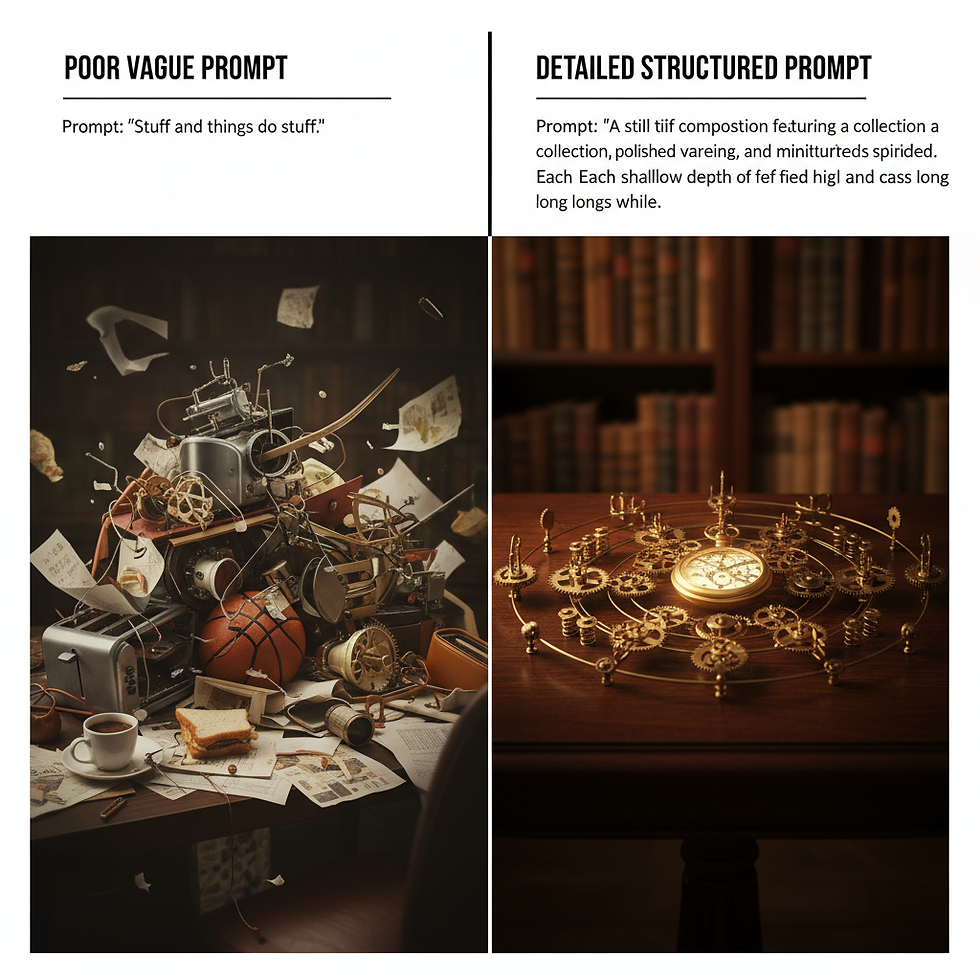
The garbage in, garbage out principle: Quality prompts create quality results
The Real Cost of Bad Prompts
When your prompts are poorly written, several problems occur:
Wasted time – You spend hours going back and forth, asking the AI to "try again" or "make it better"
Generic outputs – The AI gives you bland, forgettable content that sounds like everyone else's
Frustration – You end up thinking AI can't help with creative or strategic work
Missed opportunities – You can't leverage AI for automation because your foundational prompts are weak
Think about working with a copywriter or agency. If your initial brief is weak, their first version (V1) will also be weak. Then you waste time giving feedback, requesting revisions, and going through multiple iterations. With AI, you have a better option: improve the prompt itself so your first output is already strong.
The Five Core Principles of Effective Prompts
Before diving into specific frameworks, understand these foundational principles that make any prompt better:
1. Clarity: Be Crystal Clear
Don't make the AI guess what you want. Instead of asking "Give me some information about digital marketing," try "List three key strategies for digital marketing that will impress my Chief Marketing Officer, focused on 2025 trends."
See the difference? The second version tells the AI:
Exactly how many strategies (three)
Who the audience is (your CMO)
What quality level you need (impressive)
What time period matters (2025 trends)
2. Specificity: Add Relevant Details
The more specific you are about what you want, the better the output. Specify:
Format: Do you want bullet points, paragraphs, or a table?
Length: How many words or sections?
Structure: What components should be included?
For example, if you ask AI to "write me an email," it doesn't know if you want:
A formal corporate announcement
A casual note from the founder
A promotional campaign with headline, copy, and button
A simple text-only message
3. Context: Give Background Information
Context is king. The AI can't read your mind about:
What industry you're in
Who your target audience is
What your brand stands for
What problems you're trying to solve
The more context you provide, the more relevant and useful the output becomes.
4. Iteration: Improve Through Refinement
If your first result isn't perfect, don't give up. Come back to your prompt and improve it. Ask yourself:
What information was missing?
What could be clearer?
What examples would help?
Pro tip: Sometimes it's better to rewrite the prompt completely rather than asking the AI to "fix" its previous answer.
5. Role: Tell AI Who It Should Be
This is perhaps the most powerful technique. When you assign the AI a specific role, it completely changes the perspective and approach.
Compare these two approaches:
Without role: "Analyze the insurance tech market in the UK"
With role: "Act as a McKinsey consultant and analyze the insurance tech market in the UK"
The second version will give you structured, strategic, corporate-style analysis with big-picture insights exactly what McKinsey is known for.
Now try this variation:
Different role: "Act as a growth marketer and identify strategies to drive revenue from insurance tech in August 2025"
Same topic, completely different output. This version will be more tactical, action-oriented, and focused on immediate revenue opportunities.
Understanding Prompt Frameworks: Your Toolkit for Success
Professional marketers use structured frameworks to ensure their prompts include all necessary elements. Let's explore the most useful ones, from simplest to most comprehensive.
APE Framework: The Quickest Method
APE stands for Action, Purpose, Expectations. This is perfect when you're working with experienced marketers or exploring new areas where you don't know all the best practices yet.
A – Action: Define the task required
P – Purpose: Explain the objective you want to achieve
E – Expectations: Describe what success looks like
Example: "Create five social media posts (Action) to promote our new product launch to Gen Z audiences (Purpose). Each post should be under 150 characters, include emoji, and feel authentic rather than corporate (Expectations)."
When to use APE: When you want the AI to bring its own knowledge and creativity without over-constraining it with too many specifications.
RTF Framework: Role, Task, Format
RTF is slightly more structured and works great for operational tasks where context might not be critical.
R – Role: What perspective should AI take?
T – Task: What needs to be done?
F – Format: How should the output be structured?
Example: "Act as a B2B SaaS strategist (Role). Recommend five marketing trends I should follow in 2025 (Task). Present them as a PowerPoint slide with headlines and bullet points (Format)."
When to use RTF: When you want to tap into general market knowledge or industry best practices without applying them to your specific company yet.
TRACE Framework: For Complex Projects
TRACE helps you manage multi-step tasks with clear progression:
T – Task: Define the objective
R – Request: Specify what you're asking
A – Action: Outline the steps needed
C – Context: Provide background
E – Example: Show what good looks like
Example: "Task: Generate a viral social media campaign. Request: Create three concepts and select the best one. Action: First research trending topics, then develop concepts, then evaluate viral potential. Context: We're a DTC wellness brand targeting women 35+. Example: Our previous successful campaign featured real customer transformation stories."
When to use TRACE: For complex projects that require the AI to follow multiple sequential steps.
RUNDOWN Framework: The Professional Standard
The RUNDOWN six-step formula is comprehensive and widely used by professional prompt engineers:
1. Task: Start with an action verb stating your request clearly
2. Context: Give all relevant background information
3. Examples: Provide references showing what "good" looks like
4. Persona: Adopt a specific viewpoint or character
5. Format: Specify the output structure
6. Tone: Define the voice and style

The RUNDOWN framework: Six essential elements for effective AI prompts
Full Example:
"Task: Create a social media strategy for our product launch.
Context: We're a natural supplement brand called The Naked Pharmacy, targeting health-conscious women aged 35+ in the US. Our value proposition is 100% natural, science-backed products with free pharmacist advice.
Examples: Reference successful campaigns from Peloton and Ritual Vitamins that combined education with community building.
Persona: Act as a social media strategist who specializes in DTC wellness brands.
Format: Deliver as a 2-page strategy document with sections for objectives, platforms, content themes, and success metrics.
Tone: Professional but empathetic, science-inspired yet approachable."
When to use RUNDOWN: For important projects where you need comprehensive, professional-quality outputs and want to minimize revisions.
Two Powerful Approaches: Mega Prompts vs. Prompt Chaining
Beyond specific frameworks, you need to understand two fundamental approaches to working with AI.
Mega Prompts: Everything Upfront
A mega prompt includes all input information in one big message sometimes literally ten pages long. You give the AI everything it needs: context, role, responsibilities, objectives, target audience, templates, examples, and guidance.
Example use case: Creating a monthly marketing strategy report for a client.
You could create a mega prompt template with sections for:
Competitor analysis
Market challenges
Target audience insights
Strategic recommendations
Tactical plans
Success metrics
Then you fill in specific client details each month and run the prompt to get a comprehensive strategy document.
When to use mega prompts:
You've done the task manually before and know all the steps
You want to save time by reducing back-and-forth conversation
You have structured information to input (brand briefs, personas, product details)
You need consistent output format (like an agency delivering the same framework to multiple clients)
You're building automation or recurring processes
Best for: Long-form blog posts, ad copy, campaign plans, content strategies, or anything based on a structured brief.
Prompt Chaining: Conversational Collaboration
Prompt chaining breaks complex tasks into smaller steps. You can even ask ChatGPT to ask YOU questions first to understand what you need.
Example opening: "I want to explore different business ideas. Please ask me questions about my skills, interests, market knowledge, and constraints so you can recommend the best opportunities for me."
Then you have a back-and-forth conversation where:
The AI asks about your talents and passions
You share your preferences and limitations
The AI probes deeper into possibilities
Together you refine ideas through discussion
When to use prompt chaining:
Your task is complex or open-ended (career decisions, business planning)
You're still figuring out your own thinking
You need a thought partner to explore problems
You want AI to provide deep research and context knowledge while you bring intuition and experience
You don't have all inputs yet and need help shaping the direction
Best for: Developing content strategies from scratch, testing brand positioning territories, co-creating product messaging, exploring new business opportunities.
Pro tip: You can use prompt chaining to CREATE mega prompts. Have a conversation with AI about what a perfect prompt for your recurring task would include, then save that refined mega prompt for future use.
The Intern Mindset: A Better Way to Work with AI
Here's a mental model that changes everything: Treat AI like a capable intern on your team.

The intern mindset: Treat AI like a capable team member who needs clear guidance
Think about working with an intern. They have good intentions and want to deliver quality work, but they need proper guidance. When an intern doesn't deliver what you expected, you don't get angry you recognize it's your job as the manager to provide better:
Direction
Context
Examples
Feedback
Training
The same applies to AI. When it gives you disappointing results, the question isn't "Why is this AI so bad?" The question is "How can I delegate better to my AI intern?"
The Intern Framework: Role, Task, Context, Structure, Style, Examples
When delegating to your AI intern, include these six elements:
1. Role: Tell them exactly who they are. "You're a social media manager working for a revolutionary wellness brand" creates a different mindset than "You're a social media manager for a traditional, conservative, reputable financial institution."
2. Task: Be crystal clear about what you want accomplished.
3. Context: Share background information that helps them understand the bigger picture.
4. Structure: Explain how you want the output organized.
5. Style: This is often overlooked but crucial. What does "good" look like at your company?
Different companies have different preferences:
Some want corporate, formal style
Others prefer tech-startup casual
Some like short memos
Others prefer detailed documents
Each industry has specific terminology and phrases
6. Examples: Show them what excellent work looks like. The more examples you provide, the better they'll understand your expectations.
Why Style Matters
As someone who works with multiple companies, I've noticed that what counts as "excellent" varies dramatically. Your AI needs to understand YOUR specific standards, tone, vocabulary, and structural preferences not just general "good marketing."
When you define style clearly, your AI intern's output becomes nearly indistinguishable from work you'd create yourself.
Practical Tips for Daily AI Use
Now that you understand frameworks and approaches, here are practical tips for everyday success:
Start Simple, Then Add Detail
Begin with a basic prompt, see what you get, then add more specificity based on what's missing.
Use Examples Liberally
The phrase "Here are examples of what I want" is incredibly powerful. Attach documents, paste text, or describe previous successful work.
Specify Format Clearly
Don't leave this to chance:
"Deliver as 5 bullet points"
"Write as a 500-word blog post"
"Create as a table with 3 columns"
"Structure as a PowerPoint outline with headlines and subpoints"
"Format for a voiceover presentation" vs. "Format as a standalone document people will read without me present"
Experiment With Roles
Try different expert roles to see how outputs change:
McKinsey consultant
Startup growth marketer
Agency creative director
Data analyst
Customer success manager
Gen Z content creator
Embrace Iteration Without Frustration
Remember: you own the situation. You're the manager. If results aren't right, take responsibility for improving your delegation rather than blaming the AI.
Build Your Personal Prompt Library
When you create a prompt that works exceptionally well, save it. Build a personal library of:
Prompts for recurring tasks
Templates you've refined
Frameworks that match your work style
Examples that consistently produce great results
Real-World Success: From Bad to Great
Let's see how applying these principles transforms results:
❌ Weak Prompt
"Write about digital marketing"
Result: Generic, unfocused content that could apply to anyone
⚠️ Okay Prompt
"Write about email marketing strategies for B2B companies"
Result: Better, but still fairly generic
✅ Strong Prompt
"Act as a B2B SaaS marketing strategist. Write a 1,000-word blog post about email nurture strategies for enterprise software companies. Target audience: Marketing Directors at companies with 500-5,000 employees. Include 5 specific tactics with examples. Tone: Professional but conversational, data-driven. Format: Introduction, 5 tactics (each with headline, explanation, and example), and conclusion with key takeaways."
Result: Highly specific, strategic, actionable content that matches your exact needs
The Bottom Line: Quality In, Quality Out
The prompt engineering revolution isn't about learning complicated technical skills. It's about applying the same thoughtful communication you'd use with any team member just adapted for AI.
Remember these core principles:
Be clear and specific – Don't make the AI guess
Provide context – Give background information that matters
Use examples – Show what "good" looks like for you
Define the role – Tell AI what perspective to take
Specify format and style – Explain exactly how you want outputs structured
Iterate without frustration – Improve your prompts when results aren't perfect
Think like a manager – Delegate to your AI intern with care and clarity
You simply need to apply thoughtful communication principles to your daily AI interactions.
Every marketer who thrived in the brief-writing era understood one truth: clear communication drives better outcomes. That hasn't changed. The only difference is that now, your most productive team member might be artificial but it still needs you to be a great manager.
Start practicing these techniques today. Your AI intern is ready to deliver excellent work it's just waiting for better guidance from you.
Resources to Continue Learning
Ready to dive deeper? Here are trusted resources for mastering prompts:
Community Libraries:
Prompts.chat – Curated templates for common tasks (https://prompts.chat/)
Learn Prompting – Free structured lessons from basics to advanced (https://learnprompting.org/)
PromptHero – Community-shared prompts for fast inspiration (https://prompthero.com/)
Official Platform Guides:
OpenAI Prompt Engineering Guide – Patterns for clearer outputs and few-shot examples (https://platform.openai.com/docs/guides/prompt-generation)
Anthropic (Claude) Guide – How Claude interprets instructions and role setup (https://docs.anthropic.com/en/docs/build-with-claude/prompt-engineering/overview)
Google Gemini Strategies – Recommended patterns including context and constraints (https://ai.google.dev/gemini-api/docs/prompting-strategies)
The era of prompt engineering has arrived. The question isn't whether you'll learn these skills it's how quickly you'll master them and gain the competitive advantage they provide.


Comments