62 - Ethical Startups: Doing Good While Growing Fast
- Revanth Reddy Tondapu
- 2 hours ago
- 8 min read


Startup culture often celebrates speed.
Grow fast. Launch quickly. Capture the market. Raise capital. Hire aggressively.
But there is another question every founder eventually has to answer:
How do we grow without compromising what we believe is right?
For an early-stage startup, ethics can sometimes feel like a secondary concern. There are customers to acquire, products to build, investors to convince, and cash to manage. It is tempting to believe that ethical considerations can be addressed after the company becomes successful.
I believe the opposite is true.
Ethics must be built into the company while it is still small.
Because once a company scales, whatever behavior exists in its early culture gets amplified. Good practices become stronger, but bad practices can become much harder to correct.
For startups like AINexLayer, particularly in the AI space, this becomes even more important. We are building technology that can work with business data, documents, knowledge, automation and decision-making workflows. Trust is therefore not something we can add later. It has to be part of the product and the company from the beginning.
Ethical growth isn't about growing slowly.
It is about growing responsibly.
Why Ethics Matters in a Startup
There are four important reasons founders should take ethics seriously.
1. Growth Creates Pressure
When a startup starts growing quickly, pressure increases everywhere.
Sales targets increase. Customers demand more. Investors expect milestones. Teams work longer hours. Competitors move faster.
Under that pressure, founders may be tempted to cut corners.
Maybe product quality is compromised to meet a deadline. Maybe customer concerns are ignored because the company wants to show growth. Maybe privacy controls are postponed because they are considered "something we'll fix later."
These decisions may appear small.
But small compromises can become large problems when the company scales.
2. Trust Is a Business Asset
Trust is one of the most valuable assets a startup can build.
Customers need to trust the product.
Employees need to trust leadership.
Investors need to trust the founders.
Partners need to trust the company.
For an AI startup, this is even more important.
If a customer gives an AI platform access to internal documents, business information or operational data, they need confidence that the company will handle that information responsibly.
A company can spend years building trust and lose it through one serious incident.
3. Ethics Can Become a Competitive Advantage
In crowded markets, technology alone is rarely enough.
Two companies may offer similar products, but customers may prefer the company they trust more.
An ethical reputation can help with:
Customer retention
Employee recruitment
Investor relationships
Partnerships
Brand reputation
Regulatory relationships
Competitors can copy features.
They cannot easily copy years of accumulated trust.
4. Sustainable Growth Is Better Than Growth at Any Cost
There is a difference between fast growth and healthy growth.
A startup can grow revenue rapidly while simultaneously accumulating:
Customer complaints
Employee dissatisfaction
Technical debt
Compliance risks
Security vulnerabilities
Unsustainable operating practices
That isn't necessarily success.
Real growth should strengthen the company rather than quietly weaken its foundations.
The Major Ethical Challenges for Startups
Ethics isn't an abstract concept.
It appears in everyday startup decisions.
Data Privacy
Data is increasingly one of the most valuable assets in modern businesses.
AI startups especially need to think carefully about how customer data is collected, stored, processed and used.
Customers should understand:
What data is being collected
Why it is being collected
How it is being used
Who can access it
How long it is retained
What controls exist around it
The goal shouldn't simply be to satisfy a compliance checklist.
It should be to create a genuine culture of responsible data handling.
For an AI platform such as AINexLayer, this becomes fundamental.
If businesses trust us with their documents, enterprise knowledge and operational information, responsible data governance becomes part of the product itself.
Fair Treatment of Employees
Startups depend heavily on people.
Early employees often work in uncertain environments, take on multiple responsibilities and accept startup risk in exchange for the opportunity to build something meaningful.
That creates a responsibility for founders.
Fair compensation, reasonable expectations, transparent communication, professional growth and respectful treatment matter.
The startup environment may require intensity, but intensity shouldn't become an excuse for exploitation.
A company cannot claim to care about its customers while treating its employees poorly.
Culture starts internally.
Environmental Responsibility
Sustainability isn't only a concern for large corporations.
Startups also make decisions about:
Cloud infrastructure
Energy consumption
Hardware
Travel
Packaging
Supply chains
Waste
Office operations
For technology companies, cloud and AI infrastructure can have significant resource requirements.
Founders don't necessarily need to solve every environmental problem immediately.
But they should understand the impact of their choices and look for opportunities to improve efficiency as the company grows.
Doing more with fewer resources is often both an environmental benefit and a business advantage.
Transparency During Difficult Times
One of the biggest tests of startup ethics isn't when everything is going well.
It is when something goes wrong.
Maybe the product has a serious bug.
Maybe revenue is below expectations.
Maybe a customer leaves.
Maybe a fundraising round doesn't happen.
Maybe the company needs to change direction.
The easiest reaction can be to hide the problem.
The better approach is transparency.
Customers don't expect startups to be perfect.
Employees don't expect every decision to succeed.
Investors don't expect every forecast to be accurate.
But they do expect honesty.
A founder who communicates difficult realities clearly can maintain trust even during difficult periods.
Build Ethics Into the Culture Early
Ethics shouldn't live inside a policy document that nobody reads.
It should become part of how the company operates.
There are four practical ways to do this.
1. Define Values Early
Your first employees help establish the company's DNA.
Values should therefore be defined early and should reflect what the founders actually believe.
Don't create generic statements simply because they sound impressive.
Instead of saying:
"We believe in excellence."
Define what excellence actually means.
For example:
"We don't knowingly ship something that puts customer trust at risk."
That is actionable.
People know what it means.
2. Create Feedback Channels
Employees need safe ways to raise concerns.
Create mechanisms for:
Honest feedback
Anonymous reporting where appropriate
Leadership discussions
Customer complaints
Security concerns
Ethical concerns
The objective isn't to create a culture where everyone is constantly worried about rules.
It is to make sure important problems can surface early.
Problems discovered early are much easier to solve than problems discovered after becoming scandals.
3. Align Incentives
People generally behave according to what organizations reward.
If the only goal is:
"Increase revenue at any cost."
Eventually, someone will interpret that literally.
If salespeople are rewarded only for closing deals, they may make promises the product cannot deliver.
If engineers are rewarded only for shipping quickly, quality may suffer.
If employees are rewarded only for short-term metrics, long-term consequences may be ignored.
The solution is to create balanced incentives.
Growth matters.
But so do:
Customer satisfaction
Retention
Product quality
Security
Compliance
Team health
Long-term value
The message should be clear:
How we achieve results matters as much as the results themselves.
4. Founders Must Lead by Example
This is probably the most important principle.
Employees watch what founders do.
If the founder talks about transparency but hides bad news, employees learn that transparency isn't really valued.
If the founder talks about customer obsession but ignores customer complaints, employees notice.
If the founder talks about work-life balance but rewards people for working every weekend, the real culture becomes obvious.
Culture isn't what is written on the wall.
Culture is what leaders do when nobody is watching.
Ethics Can Actually Accelerate Growth
Doing the right thing doesn't necessarily mean sacrificing growth.
In many cases, ethical behavior can become a growth strategy.
Mission-Driven Business Models
The strongest businesses can connect financial success with solving meaningful problems.
When the business creates genuine value for customers and society, growth becomes a natural result of delivering that value.
For example, an AI platform that helps organizations reduce repetitive work, make better decisions and use their existing information more effectively can create both commercial and operational value.
The business grows because customers genuinely benefit.
Inclusive Growth
Technology should not unnecessarily exclude people.
Founders should consider:
Accessibility
Affordability
Different user capabilities
Language diversity
Different levels of digital maturity
This is particularly relevant in India.
A product designed only around the assumptions of a major metropolitan technology company may not work equally well for businesses and users across India's diverse regions.
Building for India's diversity can actually create a much larger market opportunity.
Responsible Scaling
Scaling doesn't mean abandoning your principles because the company has become bigger.
If anything, scaling makes those principles more important.
As the company grows, founders should continuously ask:
Can we maintain the quality, privacy, transparency and fairness that existed when we were small?
If the answer is no, the company needs better systems.
Responsible scaling means creating those systems before problems become unavoidable.
Work With Regulators, Not Against Them
Startups sometimes see regulation as an obstacle.
But particularly in areas such as AI, fintech, healthcare, mobility and data, regulation often exists because the technology can have real-world consequences.
Instead of asking:
"How can we avoid regulation?"
A better question is:
"How can we build responsibly while understanding the regulatory environment?"
This approach can create better relationships with customers, governments and enterprise partners.
For Indian startups, understanding India's evolving technology, data and AI regulatory environment should become part of responsible growth rather than an afterthought.
Lessons From Real Companies
Several well-known companies demonstrate different sides of the relationship between ethics and growth.
Patagonia
Patagonia built sustainability into its identity rather than treating it as a marketing campaign.
Its story demonstrates that environmental responsibility can become part of a company's competitive positioning.
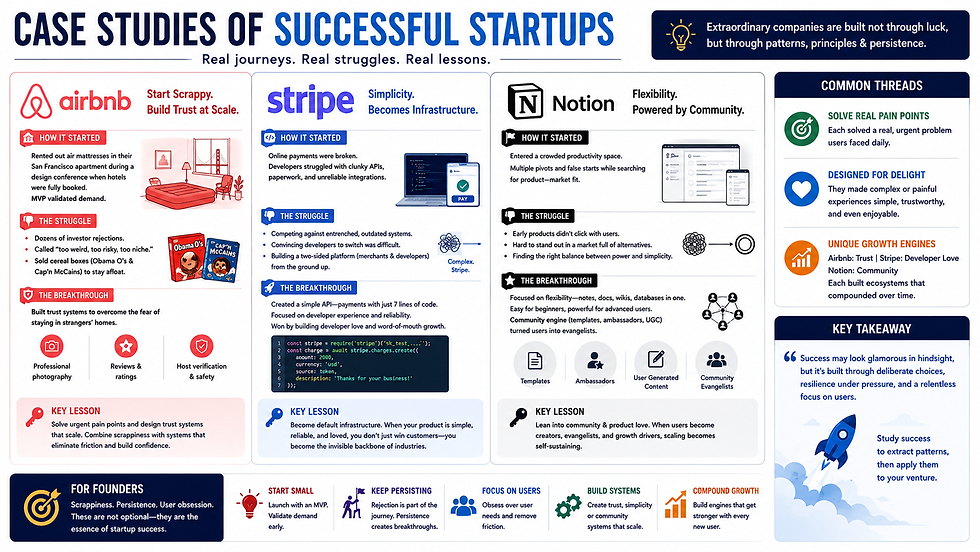
Airbnb
Airbnb had to overcome major trust and regulatory challenges.
Building systems around reviews, identity, safety and trust helped make the idea of staying in another person's home more acceptable to users.
Facebook demonstrates the other side of the equation.
Rapid growth combined with significant controversies around privacy and content moderation created enormous reputational and regulatory challenges.
The broader lesson isn't that growth itself is bad.
It is that growth without appropriate guardrails creates fragility.
Ethics Is Especially Important in AI Startups
For companies building AI products, ethical considerations become even more important because AI increasingly influences how people work and make decisions.
An AI startup should think about questions such as:
Where does the data come from?
Does the customer understand how their data is processed?
Are AI-generated results presented appropriately?
Can users verify important outputs?
What happens when the system makes a mistake?
Are sensitive business documents protected?
Who has access to customer information?
How are models and third-party AI services being used?
Can customers control their data?
These aren't just technical questions.
They are business questions.
Trust will increasingly become one of the biggest differentiators in enterprise AI.
Building AINexLayer With Responsible Growth in Mind
For us, building AINexLayer isn't only about creating another AI product.
It is about building a platform that businesses can trust.
When AI interacts with enterprise information, trust has to exist at multiple levels:
Data → Infrastructure → AI Models → Applications → People → Governance
That means responsible design needs to be considered alongside product features, customer acquisition and revenue.
The objective isn't to slow down innovation.
It is to make sure innovation creates sustainable value.
That's the mindset I believe Indian startups should increasingly adopt.
We don't need to choose between technology and responsibility.
We can build both.
Final Takeaway
Startups don't need to choose between doing good and growing fast.
The real challenge is learning how to grow without compromising the principles that make the company worth building in the first place.
The key lessons are straightforward:
Protect customer data.
Treat employees fairly.
Build transparency into the culture.
Consider environmental impact.
Create safe feedback mechanisms.
Align incentives with sustainable outcomes.
Lead by example.
Build responsibly as you scale.
Treat regulation as part of the operating environment.
Make trust a core business asset.
Patagonia shows how values can become a competitive advantage.
Airbnb demonstrates the importance of trust.
Facebook demonstrates what can happen when growth outpaces ethical guardrails.
For founders, the most important lesson is this:
Ethics isn't something you add after achieving success. It is part of how you build success.
A startup can move quickly, compete aggressively and pursue ambitious growth while still treating customers, employees, partners and society responsibly.
In fact, that may be the better way to build.
Because growth can create a big company.
Trust creates a company that can last.
Try AINexLayer
If you want to explore how AI can help businesses work with their data, analytics, documents and workflows, you can try AINexLayer → app.ainexlayer.com.
The same principle applies here: start with a focused problem, understand the customer deeply, validate the value, and then expand from a strong foundation.
Start with evidence. Build with focus. Scale with vision.


Comments