61 - Case Studies of Successful Startups: Airbnb, Stripe, and Notion

Updated: Aug 31
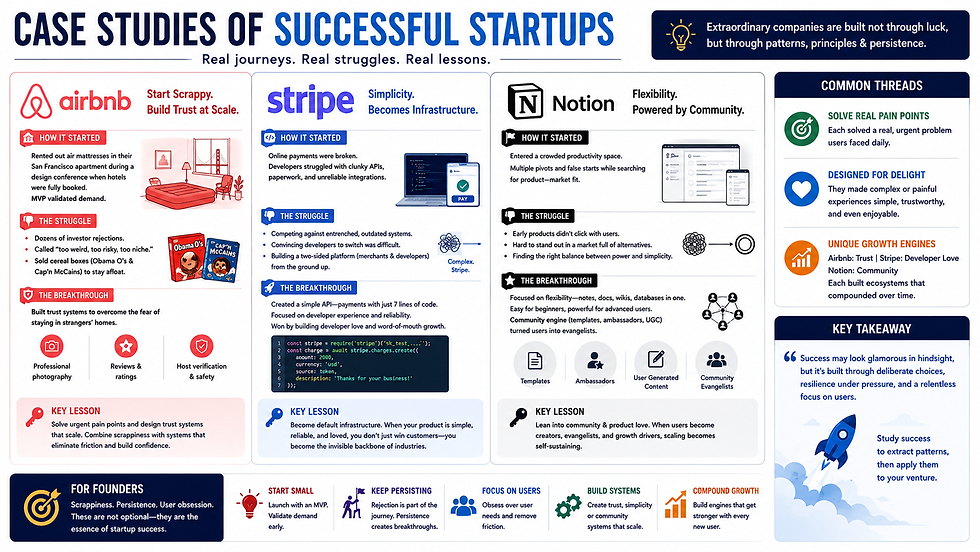
When we study startups, it is easy to focus on failure.
The companies that ran out of money.The products nobody wanted.The founders who couldn't find product-market fit.
Those stories are valuable because they teach us what to avoid.
But successful startups teach us something equally important: what to repeat.
The journeys of Airbnb, Stripe, and Notion show that successful startups rarely begin with perfect products, unlimited resources, or immediate investor support. They begin with a real problem, a small experiment, persistent founders, and a willingness to keep improving.
For me, these stories are particularly relevant while building AINexLayer. The technology may be different, but the fundamental startup questions remain the same:
Are we solving a real problem? Are customers getting value? Are we making the product simple enough to use? And can we build a growth engine that compounds over time?
Let's look at what these three companies can teach us.
Why Study Successful Startups?
Success stories are not just motivational stories.
They can be practical case studies.
There are four reasons founders should study them.
1. Success leaves patterns
When companies in completely different industries follow similar principles, those patterns are worth understanding.
Airbnb, Stripe, and Notion operate in very different markets, yet all three focused intensely on user problems and created products that people genuinely wanted to use.
2. Success includes struggle
Looking at a company after it becomes successful can make the journey appear easy.
It wasn't.
Airbnb faced rejection. Stripe entered a difficult payments market. Notion went through multiple iterations before finding its direction.
The difficult periods are often where the most valuable lessons are found.
3. Execution matters more than ideas
Thousands of founders have similar ideas.
The difference is often execution.
How quickly do you learn?
How well do you understand customers?
How effectively do you remove friction?
How consistently do you improve the product?
These are the details that turn an idea into a company.
4. Success stories provide practical inspiration
The goal isn't to copy Airbnb, Stripe, or Notion.
It's to understand why certain decisions worked and then apply those principles to your own business.
Airbnb: Start Scrappy, Then Build Trust
Airbnb's early story is one of the best examples of startup scrappiness.
The founders began with a very simple experiment.
During a design conference in San Francisco, hotels were fully booked, so they rented out air mattresses in their apartment.
It wasn't a sophisticated platform.
It wasn't a global marketplace.
It was simply an experiment that tested whether people would pay for an alternative accommodation option.
That is an important startup lesson.
You don't always need to build the complete product to validate the idea.
Sometimes the smallest possible experiment can tell you whether the problem is real.
Persistence Through Rejection
Airbnb's early journey wasn't easy.
The founders faced significant investor rejection.
Many people struggled to understand the concept of staying in a stranger's home.
Instead of giving up, the founders continued experimenting and finding ways to survive.
One memorable example was selling novelty cereal boxes—Obama O's and Cap'n McCains—to generate cash.
It sounds unusual.
But that's exactly the point.
Early-stage startups don't always have the resources to solve problems conventionally.
Scrappiness becomes an advantage.
The founders were willing to do whatever was necessary to keep the company alive long enough to learn.
Airbnb's Real Breakthrough: Trust
But Airbnb needed more than accommodation listings.
It needed to solve a much bigger problem:
Would people trust strangers enough to stay in their homes?
Airbnb built systems around that problem.
Professional photography helped listings look credible.
Reviews helped users evaluate hosts and properties.
Verification mechanisms helped establish confidence.
These weren't just features.
They were trust infrastructure.
This is one of the most important lessons from Airbnb.
A startup doesn't only need to solve the obvious customer problem.
It also needs to solve the friction and fear surrounding that problem.
For Airbnb, the product wasn't simply "find a place to stay."
It was also:
"Feel confident staying in a place offered by someone you don't know."
That trust layer became fundamental to the marketplace.
Stripe: Simplicity Can Become a Growth Strategy
Stripe started with a different problem.
Online payments were difficult for developers.
Integrating payment systems often involved complicated processes, outdated interfaces, and significant technical friction.
The Collison brothers recognized an opportunity to make payments dramatically simpler.
Stripe's approach was developer-first.
The goal was to make it incredibly easy for developers to integrate payments into their applications.
Instead of forcing developers to navigate complicated systems, Stripe focused on elegant APIs and a simple developer experience.
That seemingly simple decision became a powerful competitive advantage.
Build for the User Who Actually Uses the Product
One of Stripe's important lessons is understanding who experiences the problem most directly.
Developers were often the people actually implementing payment infrastructure.
Stripe focused heavily on making their lives easier.
That created something more powerful than traditional marketing:
developer love.
When developers found Stripe easier to use, they recommended it to other developers.
The product itself became part of the distribution strategy.
This is a powerful startup concept.
Your marketing doesn't always have to be separate from your product.
If the product is genuinely useful, easy to adopt, and enjoyable to use, customers can become part of your growth engine.
Becoming Infrastructure
Stripe didn't simply want to become another payment company.
It became infrastructure for internet businesses.
That's an important distinction.
When your product becomes embedded inside another company's operations, replacing it becomes harder.
The product becomes part of the customer's foundation.
For founders, the lesson is:
Don't just build something people buy. Build something they depend on.
For AINexLayer, this is an especially important principle.
If an enterprise uses AINexLayer to connect knowledge, data, AI workflows, analytics, and decision-making processes, the objective shouldn't simply be to become another AI tool.
The bigger opportunity is to become part of the organization's AI operating layer.
That is a much stronger position.
Notion: Persistence, Flexibility, and Community
Notion provides a different lesson.
Its journey involved experimentation and multiple iterations before the product found strong product-market fit.
The productivity software market was already crowded.
There were plenty of tools for notes, documents, wikis, databases, and project management.
So Notion needed to differentiate itself.
Its answer was flexibility.
Instead of forcing users into a rigid workflow, Notion gave users building blocks that could be combined in different ways.
Users could create:
Notes
Documents
Wikis
Databases
Project systems
Knowledge bases
Custom workflows
The product became flexible enough that different users could use it in completely different ways.
The Power of Product Flexibility
This created an interesting balance.
A beginner could start with something simple.
A sophisticated user could build an extremely complex workspace.
That flexibility allowed Notion to serve different types of users without forcing everyone into the same workflow.
For startup founders, this provides an important lesson:
Don't confuse simplicity with limitation.
A product can have a simple entry point while still providing significant depth for advanced users.
The best products often make the first experience easy while allowing users to discover more powerful capabilities over time.
Turning Users Into the Marketing Team
Perhaps one of Notion's most powerful growth mechanisms was its community.
Users created templates.
They shared workflows.
They taught other people how they used Notion.
They created content around the product.
Ambassadors helped spread the product.
In other words, Notion didn't rely entirely on traditional marketing.
Its users became educators, creators, and evangelists.
This creates a powerful growth loop:
Use the product → create something useful → share it → attract another user → repeat.
That's much more powerful than simply buying advertisements.
The lesson is clear:
When customers love your product enough to teach others how to use it, you've created a powerful growth engine.
What Airbnb, Stripe, and Notion Have in Common
These companies look very different.
Airbnb built a global marketplace.
Stripe built internet payment infrastructure.
Notion built a flexible productivity platform.
Yet several common principles emerge.
1. They solved real problems
Airbnb addressed accommodation constraints.
Stripe addressed painful online payment integration.
Notion addressed the limitations of rigid productivity tools.
None of these companies succeeded simply because they had impressive technology.
They succeeded because people found their products valuable.
For any startup, including AINexLayer, this is the first question:
What painful problem are we solving, and how strongly do customers care about it?
2. They focused on user experience
Airbnb reduced trust friction.
Stripe reduced technical friction.
Notion reduced workflow limitations.
All three made something difficult feel easier.
That is a powerful product strategy.
Customers don't necessarily care about how technically sophisticated your architecture is.
They care about whether the experience solves their problem.
3. They created unique growth engines
This may be the most important similarity.
Airbnb built around trust and marketplace effects.
Stripe built around developer adoption and product love.
Notion built around community and user-generated content.
They didn't simply acquire customers one at a time.
They built systems where each successful customer could help create additional growth.
That's the difference between growth and a growth engine.
What This Means for AINexLayer
These lessons are directly applicable to an AI startup.
AINexLayer operates in a rapidly changing AI environment where simply saying "we use AI" isn't enough.
There are countless AI platforms, models, agents, RAG systems, analytics tools, and automation products.
The important question is not:
"How much AI technology can we put into the platform?"
The better question is:
"How much meaningful work can we remove from the customer's problem?"
That distinction matters.
If AINexLayer can make enterprise knowledge easier to access, transform organizational data into insights, connect AI with business workflows, and help teams make better decisions, then the value isn't the underlying model.
The value is the outcome.
Just as Stripe abstracted away payment complexity, an AI platform should ideally abstract away AI complexity.
Customers shouldn't have to worry about which model is running underneath every workflow.
They should care that the problem gets solved.
Three Startup Principles I Take From These Stories
After looking at Airbnb, Stripe, and Notion, I would summarize their lessons into three principles.
Be scrappy like Airbnb.
Don't wait for perfect resources.
Start with what you have.
Validate quickly.
Find creative ways around constraints.
Be relentlessly simple like Stripe.
Remove complexity for customers.
Make difficult technology feel easy.
Build around the people who actually use your product.
Build community like Notion.
Give users something worth sharing.
Let customers teach each other.
Turn product usage into distribution.
Together, these principles create a powerful startup philosophy:
Solve a real problem → make the experience simple → create a reason for users to bring others.
Final Takeaway
The success stories of Airbnb, Stripe, and Notion are not fairy tales.
They are examples of companies that faced uncertainty, rejection, competition, and product challenges before finding their path.
Airbnb teaches us the power of scrappiness and trust.
Stripe teaches us the power of simplicity and developer-focused product design.
Notion teaches us the power of flexibility, product love, and community-driven growth.
The biggest lesson is that successful startups don't simply build products.
They build systems that create value repeatedly.
For founders, the goal should not be to copy these companies.
It should be to understand their underlying principles and apply them to a completely different problem.
Because every startup has its own market, customers, technology, and constraints.
The patterns, however, are remarkably consistent.
Find a real problem. Build something people genuinely value. Make it incredibly easy to use. Listen to users. Stay resilient through rejection. And create a growth engine that becomes stronger with every customer.
That's how a small experiment can eventually become something extraordinary.
Try AINexLayer
If you want to explore how AI can help businesses work with their data, analytics, documents and workflows, you can try AINexLayer → app.ainexlayer.com.
The same principle applies here: start with a focused problem, understand the customer deeply, validate the value, and then expand from a strong foundation.
Start with evidence. Build with focus. Scale with vision.


Comments