55 - Performance, Compensation & ESOPs: Building a Team That Thinks Like Owners

Updated: Aug 29
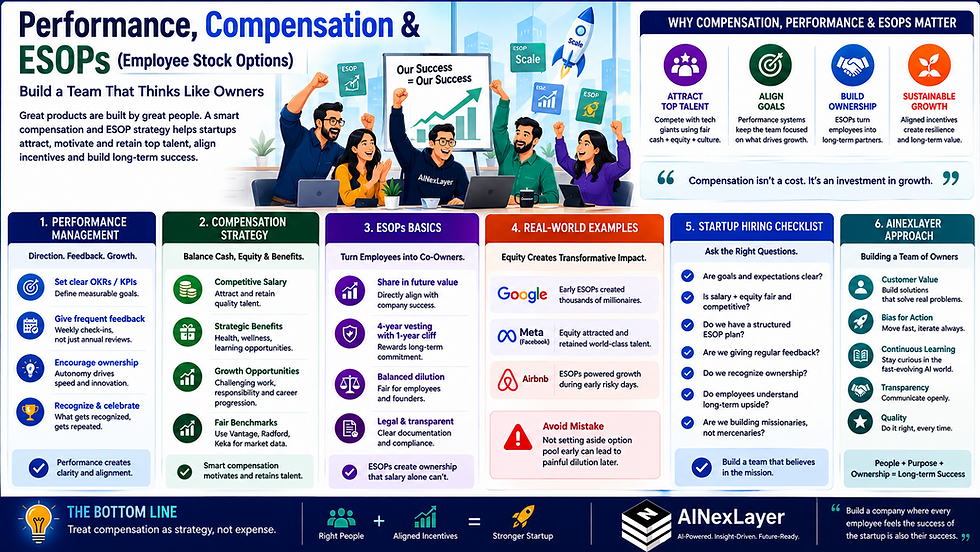
When I started thinking about building AINexLayer, one thing became clear very quickly: product and technology alone cannot build a great startup. People do.
A strong architecture, a good AI platform, and an ambitious roadmap can take a startup only so far. Eventually, the real differentiator becomes the people behind the company—their creativity, execution, ownership, and willingness to solve problems when things don't go according to plan.
For an early-stage startup like AINexLayer, this becomes even more important.
We are competing for talent with companies that can offer significantly higher salaries, established brands, and predictable career paths. As a startup, we may not always be able to win on cash compensation.
So the question becomes:
How do we attract great people, keep them motivated, and make them genuinely invested in the company's success?
This is where performance management, compensation, and ESOPs become strategic tools rather than HR formalities.
Compensation Is a Startup Strategy, Not Just an Expense
In a traditional company, compensation can sometimes be treated as an operating expense.
In a startup, I see it differently.
Compensation is an investment in execution.
Every person we bring into AINexLayer has an impact on our runway, but they also have the potential to multiply our output.
A great engineer can solve problems that would otherwise take months.
A strong salesperson can open an entirely new customer segment.
A good product person can turn customer feedback into a product direction.
A strong operations person can remove bottlenecks across the organization.
So the objective isn't simply to minimize salaries.
It is to find the right balance between:
Competitive salary
Equity upside
Benefits
Learning opportunities
Responsibility
Company culture
Long-term growth
For a startup, this combination can be much more powerful than salary alone.
Performance Must Be Connected to Company Goals
One of the biggest challenges in an early-stage company is making sure everyone is working toward the same outcome.
At AINexLayer, for example, we may have people working across AI engineering, product development, cloud infrastructure, sales, customer success, and operations.
If everyone defines success differently, the company can move in multiple directions at the same time.
That's dangerous.
This is where OKRs and KPIs become useful.
Instead of saying:
"Work on the product."
We should be able to define something much clearer:
"Improve the reliability of the RAG pipeline, reduce response latency, and make the deployment process easier for enterprise customers."
Similarly, for sales:
"Build a qualified enterprise pipeline, convert pilot opportunities, and establish repeatable customer acquisition."
The objective is not to create unnecessary corporate bureaucracy.
It is to create clarity.
Everyone should understand:
What am I responsible for?
How will success be measured?
How does my work contribute to AINexLayer's larger goal?
Startups Cannot Wait for Annual Performance Reviews
One thing I strongly believe is that startups move too quickly for traditional annual performance reviews to be the primary feedback mechanism.
Imagine someone making a mistake in January and discovering during a December review that the company has been unhappy with their performance.
That's far too late.
Early-stage companies need continuous feedback.
For AINexLayer, this can mean:
Regular one-on-one discussions
Weekly or biweekly goal reviews
Project retrospectives
Customer feedback discussions
Technical reviews
Product reviews
Immediate recognition of good work
Immediate correction when something is going wrong
The purpose isn't to constantly evaluate people.
It is to help people improve while there is still time to change the outcome.
That's particularly important in a startup where priorities can change rapidly.
A feature that was critical three months ago may no longer be the priority today.
The team needs enough context and autonomy to adapt.
Ownership Is More Important Than Supervision
One of the characteristics I look for in startup employees is ownership.
In a large organization, someone might say:
"That's not my responsibility."
In a startup, that mindset can become dangerous.
At AINexLayer, if a customer encounters a problem, it shouldn't matter whether the issue technically belongs to engineering, product, infrastructure, or customer success.
The first question should be:
"How do we solve it?"
That's what ownership means to me.
Ownership doesn't mean that one person does everything.
It means that people don't wait for someone else to solve problems that are clearly affecting the company's mission.
The best startup employees don't simply complete assigned tasks.
They see problems, understand the larger context, and take responsibility for outcomes.
Recognition Is Also Compensation
Money matters.
But money isn't the only thing that motivates people.
Recognition matters too.
When someone at AINexLayer solves a difficult technical problem, closes an important customer opportunity, improves the product, or goes beyond what was expected, that contribution should be recognized.
Recognition tells the rest of the team:
"This is the kind of behavior we value here."
For example, if someone takes ownership of a difficult customer issue and resolves it successfully, recognizing that behavior reinforces a culture of customer ownership.
If an engineer creates an improvement that significantly reduces infrastructure costs, recognizing it demonstrates that efficiency matters.
What gets recognized gets repeated.
How Should a Startup Structure Compensation?
There isn't one perfect compensation model for every startup.
But I believe a startup should think about compensation as a combination of several elements.
1. Salary
The salary needs to be competitive enough to attract and retain good people.
You don't necessarily need to match the largest technology companies, but paying substantially below the market will eventually create problems.
Good people have choices.
2. Equity
This is where startups have an advantage.
A startup can offer employees something that a traditional salary cannot:
participation in the company's future value.
If someone joins AINexLayer at an early stage and helps us build something valuable, their contribution should have the potential to create meaningful upside for them.
3. Benefits
Benefits such as health coverage, learning opportunities, flexible working arrangements, and professional development can significantly influence an employee's overall experience.
4. Growth
Compensation is also about career progression.
People want to know:
What can I learn here?
What responsibility can I take?
What can I become?
How will my contribution be recognized?
For an early-stage employee, the opportunity to build something from the ground up can itself be extremely valuable.
ESOPs: Turning Employees Into Owners
This is where Employee Stock Option Plans (ESOPs) become particularly interesting for startups.
An ESOP gives eligible employees the opportunity to purchase company shares in the future at a predetermined exercise price, subject to the plan's terms.
The important idea is simple:
Employees can participate in the value they help create.
Suppose someone joins AINexLayer at an early stage.
At that point, the company is still building its products, acquiring customers, developing technology, and proving the business model.
The employee is taking a risk by joining early.
If that employee contributes significantly and the company eventually becomes much more valuable, their equity can provide meaningful upside.
That creates a completely different psychological relationship with the company.
They aren't simply thinking:
"I work for AINexLayer."
They can start thinking:
"I am helping build AINexLayer."
That distinction matters.
Vesting Makes ESOPs Work for the Long Term
ESOPs generally aren't given as immediately owned shares.
A common startup structure is a four-year vesting schedule with a one-year cliff, although actual structures vary depending on the company, jurisdiction, plan and employee.
The basic concept is straightforward.
An employee earns their equity over time.
For example, if an employee receives an option grant subject to a four-year vesting schedule with a one-year cliff, they generally need to remain with the company for the first year before the initial portion vests. The remaining portion then typically vests over the following period.
This creates alignment.
The company doesn't give away its entire equity commitment on day one.
The employee has an incentive to stay and contribute.
Both sides are thinking about the long term.
For an early-stage startup, that alignment is extremely valuable.
ESOPs Should Not Be Treated as Free Money
There is also an important lesson here for founders.
Equity has real value.
Founders should not casually distribute equity simply because they don't have enough cash.
At the same time, founders shouldn't treat every percentage of equity as something that must be protected at all costs.
The right question is:
What amount of equity can create enough motivation to attract someone who can materially increase the value of the company?
If giving a meaningful equity grant helps bring in someone who can transform engineering, sales, product, or operations, the dilution may ultimately be worth it.
The goal isn't to preserve 100% of a small company.
The goal is to build a much more valuable company while creating a fair ownership structure.
The Option Pool Needs Planning
Another important lesson for founders is the need to plan an employee option pool early.
If you wait until after investors arrive and then suddenly realize you need equity for future employees, the negotiation can become much more complicated.
Investors may expect an option pool to be created or increased as part of the financing.
That can have dilution implications for existing shareholders.
For a startup like AINexLayer, employee equity should therefore be considered as part of the broader capitalization strategy—not as something to figure out at the last minute.
The cap table should be designed with future hiring in mind.
What I Would Focus on at AINexLayer
For me, the most important part isn't simply implementing an ESOP.
It is creating an environment where the equity actually means something.
If someone receives equity but doesn't understand:
What it represents
How vesting works
What the exercise price means
What happens during future funding rounds
How dilution works
What could happen during an acquisition or exit
then the motivational value of the ESOP can be lost.
So communication and education are just as important as the plan itself.
People should understand what they are receiving and why.
Compensation, Performance and Equity Must Work Together
I don't see performance management, compensation, and ESOPs as three separate HR activities.
They are interconnected.
Performance defines what contribution looks like.
Compensation rewards the contribution being made today.
Equity creates an incentive for the value created tomorrow.
For example, imagine an early AINexLayer engineer who is responsible for a critical AI infrastructure component.
Their performance goals might include improving system reliability, reducing inference costs, and delivering key product capabilities.
Their compensation rewards their current contribution.
Their ESOP gives them a potential stake in the long-term value created if those improvements help AINexLayer scale.
That's a much stronger alignment than salary alone.
The AINexLayer Perspective: Building Missionaries, Not Mercenaries
This is probably the most important lesson I take from this topic.
A startup needs people who believe in the mission.
People who are willing to solve problems when there isn't a predefined process.
People who care about customers.
People who learn quickly.
People who take ownership.
People who want to build something rather than simply hold a job.
At AINexLayer, the goal is not just to assemble a group of employees.
The goal is to build a team that believes in the vision of creating an AI platform capable of solving real enterprise problems.
That means compensation needs to be fair.
Performance expectations need to be clear.
And equity needs to be used thoughtfully to create long-term alignment.
The Bigger Lesson
Companies such as Google, Facebook, and Airbnb demonstrated how employee equity can create enormous wealth and strengthen alignment when employees join early and the company grows significantly.
But the underlying principle applies to startups at every stage.
You don't need to be a billion-dollar company today to start thinking about ownership.
You need to understand that the people who help create your company's future should have a meaningful reason to care about that future.
Performance management provides direction.
Compensation provides immediate reward.
ESOPs provide long-term alignment.
Together, they create a system where employees aren't simply working for the company—they are helping build its future.
Final Takeaway
As founders, it is easy to think about compensation as another number in the monthly burn-rate calculation.
But that is only one side of the equation.
The right compensation strategy can help you compete for talent.
The right performance system can create accountability and clarity.
The right ESOP structure can turn early employees into long-term partners.
For a startup like AINexLayer, where every early team member can have a disproportionate impact on the company's trajectory, this alignment is incredibly important.
Treat compensation as strategy, not expense.
Pay fairly. Set clear expectations. Recognize contribution. Give people ownership where it makes sense.
Because ultimately, the strongest startups aren't built by founders alone.
They are built by teams who feel that the success of the company is also their success.
Try AINexLayer
If you want to explore how AI can help businesses work with their data, analytics, documents and workflows, you can try AINexLayer → app.ainexlayer.com.
The same principle applies here: start with a focused problem, understand the customer deeply, validate the value, and then expand from a strong foundation.
Start with evidence. Build with focus. Scale with vision.


Comments