49 - Anatomy of a Winning Pitch Deck: How I Think About Fundraising as a Founder

Updated: Aug 28
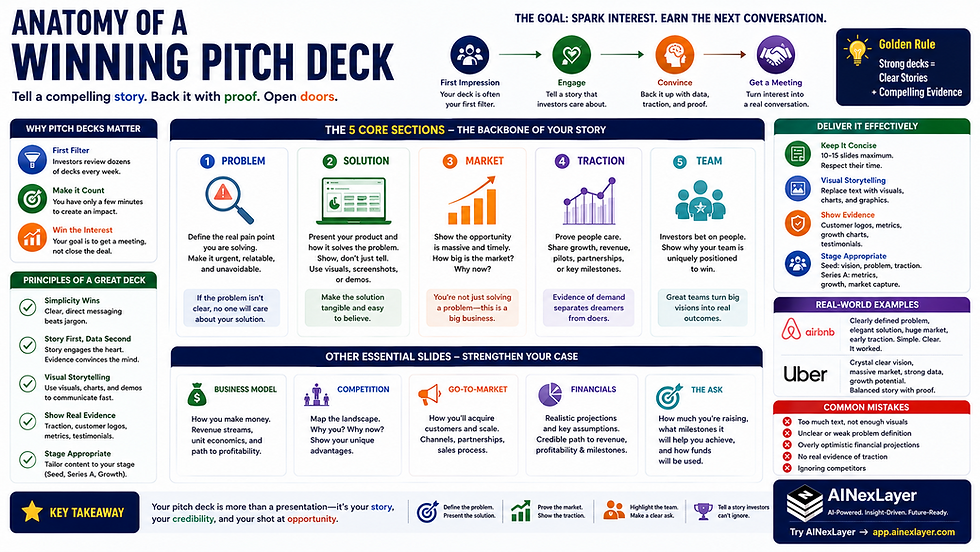
When I started thinking seriously about building AINexLayer, I quickly realized that building the product was only one part of the startup journey.
At some point, every founder has to explain what they are building, why it matters, who needs it, how big the opportunity is, and why their team is capable of executing the vision.
That is where a pitch deck becomes important.
A pitch deck is not simply a PowerPoint presentation. It is the story of your company compressed into a few slides. It is often the first thing an investor, accelerator, grant committee, strategic partner, or potential customer sees before deciding whether they want to have a conversation with you.
And when you are competing for attention, clarity matters enormously.
A Pitch Deck Is Your First Conversation With an Investor
Investors see a huge number of startups. They don't have the time to understand every company in depth from the beginning.
Your pitch deck therefore has a very specific job.
It needs to make the investor interested enough to ask for the next conversation.
It doesn't have to answer every possible question. It doesn't need to contain every feature of your product. And it certainly doesn't need 40 slides explaining your entire architecture.
The deck needs to tell a clear story:
Problem → Solution → Market → Traction → Business → Team → Opportunity → Ask
When I think about AINexLayer, this becomes particularly important because AI platforms can become technically complicated very quickly.
I could spend several slides explaining RAG, vector databases, AI agents, model orchestration, MCP workflows, document intelligence, analytics, and infrastructure.
But an investor doesn't first need to understand all of that.
The first question is much simpler:
What problem are we solving, and why does the market care?
Technology should support the story, not become the story.
Start With the Problem
A strong pitch deck begins with the problem.
Not with your logo.
Not with your technology.
Not with a list of features.
The investor needs to understand what is broken today.
For example, businesses have enormous amounts of information spread across documents, databases, spreadsheets, applications, dashboards, and operational systems. Getting useful answers from that information often requires technical teams, analysts, and multiple disconnected tools.
That is the kind of problem I want to communicate when presenting AINexLayer.
The important thing is to make the problem understandable even to someone who has never seen the product.
A good problem statement should make the investor think:
"Yes, I have seen this problem before."
The more clearly you communicate the pain, the more valuable your solution becomes.
Then Show the Solution
Once the problem is clear, the next slide should make the solution feel obvious.
This is where AINexLayer can become tangible.
Instead of simply saying that AINexLayer is an enterprise AI platform, I would show what happens when a business connects its information and interacts with it using natural language.
A user shouldn't need to understand the underlying architecture to understand the outcome.
They should be able to see something like:
Business data → AI understanding → Question → Answer → Insight → Action
That is much more powerful than filling a slide with technical terminology.
For AINexLayer, I would also demonstrate how conversational AI, RAG, document intelligence, analytics, and agentic workflows come together to help organizations work with their data.
The pitch should make the investor understand the value before the technology.
Explain the Market Opportunity
A great solution isn't enough.
Investors want to know whether the opportunity is large enough to build a significant company.
This is where market sizing becomes important.
You need to answer questions such as:
Who are the customers?
How many potential customers exist?
What are they spending today?
How quickly is the market growing?
Why is this the right time to enter?
What larger market can you expand into?
For an Indian startup like AINexLayer, I also think it is important not to position India merely as a low-cost development market.
India itself is a massive technology market, with enterprises across manufacturing, banking, logistics, healthcare, government, education, and other sectors undergoing digital transformation.
That creates an opportunity to build in India while thinking globally from the beginning.
The pitch should therefore answer not only "How big is India?", but also:
"How does this company become a global business?"
Why Now Matters
One question I always think about when explaining a startup is:
Why now?
A problem may have existed for ten years, but the timing for solving it may only have become attractive recently.
For AINexLayer, the rapid development of generative AI, enterprise adoption of AI, better open-source models, increasingly capable cloud infrastructure, and the growing demand for organizations to make use of their existing data all contribute to the timing.
This creates a stronger story than simply saying:
"AI is growing."
The pitch needs to explain what has changed that makes the solution possible now.
Traction Turns a Story Into Evidence
One of the biggest differences between an idea and a business is evidence.
This is why traction is such an important part of a pitch deck.
Traction doesn't always mean millions of users or crores of revenue.
Depending on the stage of your startup, traction could include:
Paying customers
Pilot customers
Product usage
Revenue
Customer retention
Partnerships
Letters of intent
Successful deployments
Waitlist growth
Strong user engagement
Enterprise conversations
For an early-stage company, even strong evidence that customers are actively testing and adopting the product can be meaningful.
The important thing is to avoid presenting activity as traction.
Having 10,000 website visitors isn't necessarily impressive if nobody uses the product.
Ten organizations actively using the product may be much more valuable.
Quality of traction matters more than vanity numbers.
Tell Investors Why Your Team Can Win
Investors don't invest only in products.
They invest in teams.
The team slide should answer one simple question:
Why are you the right people to solve this problem?
For AINexLayer, I would connect my background, product understanding, technology experience, enterprise exposure, and execution capability directly to the problem we are solving.
Don't simply list job titles.
Explain the connection between your experience and the opportunity.
An investor should come away thinking:
"This team has a credible reason to win."
Explain How the Business Makes Money
A pitch deck also needs a business model.
How do you generate revenue?
For a SaaS or enterprise AI company, this could involve subscriptions, usage-based pricing, enterprise licensing, implementation services, or a combination of models.
For AINexLayer, the important thing is to explain how customers move from adopting the platform to becoming recurring revenue.
The investor doesn't necessarily expect the business model to be perfect at an early stage.
But they do expect you to have thought about it.
Your deck should demonstrate that you understand:
Customer → Product Usage → Value → Payment → Expansion
That is the foundation of a scalable business.
Show the Competitive Landscape
Never say:
"We have no competitors."
If you believe you have no competitors, you probably haven't defined the problem correctly.
Your competition may be another startup, a large enterprise platform, internal development teams, consultants, spreadsheets, legacy software, or simply the customer's decision to do nothing.
For AINexLayer, the competitive landscape can include enterprise AI platforms, analytics tools, RAG platforms, internal AI solutions, and traditional data-analysis workflows.
The important question isn't whether competitors exist.
It is:
Why will customers choose us?
That differentiation could come from product capabilities, ease of deployment, architecture, integrations, pricing, vertical specialization, customer experience, or another genuine advantage.
Explain Your Go-To-Market Strategy
A great product still needs a path to customers.
This is where your GTM strategy becomes part of the pitch.
Investors want to understand:
Who is your ideal customer?
How do you reach them?
Who makes the buying decision?
How long is the sales cycle?
What is your customer acquisition strategy?
What is the expected customer lifetime value?
How does the model scale?
For AINexLayer, an enterprise-focused GTM approach could involve direct sales, strategic partnerships, system integrators, industry relationships, pilots, and targeted outreach.
The important point is to show that customer acquisition isn't based on hope.
There needs to be a repeatable mechanism behind it.
Financials Should Tell a Credible Story
Financial projections are another important part of the deck.
But this is where founders often make a mistake.
They create a graph that goes:
₹1 crore → ₹10 crore → ₹100 crore → ₹500 crore
and assume investors will be impressed.
Usually, the opposite happens.
Investors want to understand the assumptions behind those numbers.
How many customers?
What pricing?
What conversion rate?
What customer acquisition cost?
What sales cycle?
What churn?
What gross margin?
How many people do you need?
How much infrastructure will you require?
Your financial model should support your pitch deck.
The deck tells the story.
The financial model provides the underlying evidence.
Make the Funding Ask Specific
The final important piece is the ask.
Don't simply say:
"We are looking for funding to grow the company."
Be specific.
Explain:
How much are you raising?
What will the capital be used for?
What milestones will the funding help you achieve?
For example, funding might be allocated toward product development, engineering, sales, marketing, infrastructure, customer acquisition, and hiring.
More importantly, connect the funding to milestones.
Instead of:
"We need ₹5 crore for growth."
Think:
"We are raising ₹5 crore to expand the engineering and GTM teams, acquire enterprise customers, strengthen the platform, and reach specific revenue and customer milestones over the next 18–24 months."
That gives the investor a reason to believe the capital has a purpose.
Keep the Deck Short
One of the most important lessons I've learned is that more information doesn't necessarily make a pitch stronger.
A strong primary pitch deck can often be around 10–15 slides.
Every slide should have a job.
A possible structure is:
Title → Problem → Solution → Product → Market → Business Model → Traction → GTM → Competition → Technology/Differentiation → Team → Financials → Funding Ask
You may need additional slides for specific investors or due diligence, but the main story should remain concise.
The investor should be able to understand the business without you standing beside every slide explaining what it means.
Tell a Story, Don't Create a Documentation File
This is probably the biggest distinction between a technical presentation and an investor pitch.
A technical presentation explains how something works.
A pitch deck explains why the company matters.
For example, I could create an AINexLayer slide saying:
"AINexLayer uses RAG, vector search, LLM orchestration, agents, MCP workflows, document intelligence and analytics."
Technically, that may be accurate.
But it isn't necessarily a compelling investor story.
A stronger approach would be:
"AINexLayer helps enterprises turn fragmented business information into actionable intelligence through conversational AI, analytics, and intelligent workflows."
Then I can use the following slides to explain how we make that possible.
Outcome first. Technology second.
What I Would Avoid in an AINexLayer Pitch
There are several mistakes I would consciously avoid.
I wouldn't put every product feature into the deck.
I wouldn't fill slides with paragraphs.
I wouldn't make unsupported claims about the market.
I wouldn't show unrealistic financial projections.
I wouldn't say that competitors don't exist.
I wouldn't spend five minutes explaining infrastructure before explaining customer value.
And I wouldn't make the presentation entirely about AI technology.
The investor is ultimately investing in a business, not simply a technology stack.
The Indian Founder Perspective
For founders building from India, there is another important consideration.
A pitch shouldn't make the company sound smaller simply because it is starting in India.
India can be the initial market, development base, customer-validation environment, or launchpad.
But the ambition can still be global.
This is particularly relevant for enterprise technology.
A company can build strong engineering capabilities in India, prove the product with Indian enterprises, establish repeatable economics, and then expand internationally.
The pitch should therefore communicate both:
Why India is a strong place to build this company
and
Why the opportunity is much larger than India.
That distinction can make the story much stronger.
Your Pitch Deck Is the Beginning, Not the End
A pitch deck doesn't need to close an investment.
Its job is to open the door.
If an investor finishes your deck and wants to know more, you have done your job.
They should want to ask:
"Who are your customers?"
"How fast are you growing?"
"Why can't Microsoft or Google do this?"
"How large can this become?"
"What happens if you raise this round?"
Those questions are opportunities.
They mean the deck created enough curiosity for the next conversation.
Final Thoughts
Building a winning pitch deck is ultimately about clarity, conviction, and credibility.
You need to explain the problem clearly.
Show the solution simply.
Demonstrate that the market is large.
Provide evidence that customers care.
Explain how the business makes money.
Show why your team can win.
Explain how you will reach customers.
Present realistic financials.
And make a specific funding ask.
When I think about AINexLayer, the same principle applies.
I don't want the investor to walk away simply thinking, "This is an interesting AI technology."
I want them to understand:
There is a significant problem.
AINexLayer solves it in a differentiated way.
Customers have a reason to adopt it.
The market is large.
The business model can scale.
And the team has the capability to build the company.
That is what a pitch deck should accomplish.
A great pitch deck doesn't try to say everything.
It makes the right things impossible to misunderstand.
And ultimately, your pitch deck isn't your company.
It's the beginning of the conversation that can help you build it.
Try AINexLayer → app.ainexlayer.com
Try AINexLayer
If you want to explore how AI can help businesses work with their data, analytics, documents and workflows, you can try AINexLayer → app.ainexlayer.com.
The same principle applies here: start with a focused problem, understand the customer deeply, validate the value, and then expand from a strong foundation.
Start with evidence. Build with focus. Scale with vision.


Comments