43 - Contracts, IP Protection, and Employment Basics: Building a Legally Strong Startup

Updated: Aug 28
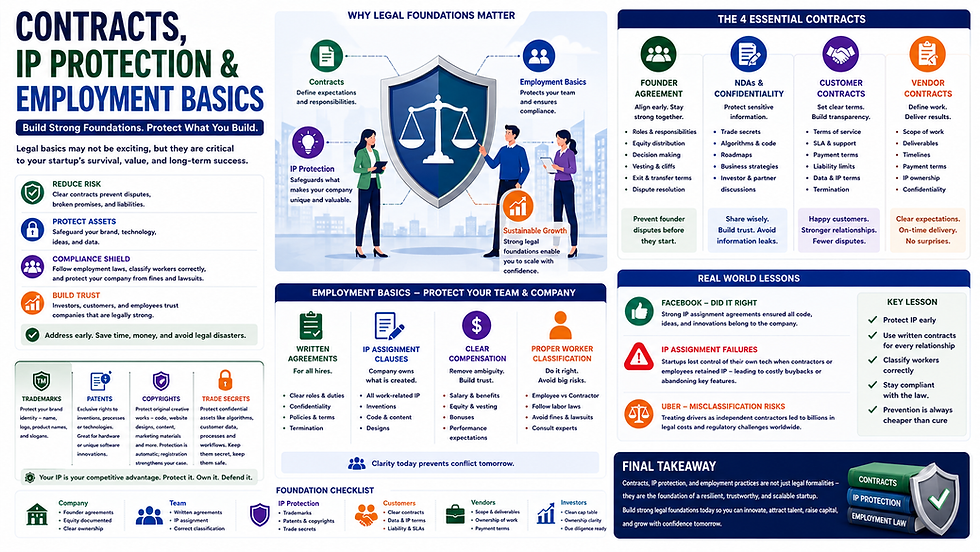
When founders talk about building a startup, the conversation usually revolves around product, technology, customers, funding, and growth.
But there is another foundation that often gets less attention until something goes wrong: legal protection.
A startup can have an excellent product and a strong market opportunity, but if its contracts are unclear, intellectual property is not properly owned by the company, or employment arrangements are poorly documented, the business can face serious problems later.
For a startup like AINexLayer, this is particularly important because the company is building technology, working with customers and partners, engaging developers and other professionals, and creating intellectual property that becomes increasingly valuable as the business grows.
Legal foundations are therefore not simply administrative work.
They are part of building a defensible, trustworthy, and scalable company.
Why Legal Foundations Matter for Startups
Legal documentation may not feel exciting during the early stages of a startup, but it protects the business in several important ways.
1. Risk mitigation
Contracts establish clear expectations between the company and the people or organizations it works with.
They define responsibilities, deliverables, payments, confidentiality, ownership, and what happens if something goes wrong.
Without written agreements, founders may find themselves relying on conversations, emails, or assumptions.
That can become dangerous when significant money or intellectual property is involved.
2. Protecting valuable assets
For technology startups, intellectual property can become one of the company's most valuable assets.
This can include:
Source code
Product architecture
Algorithms
Brand identity
Product names
Designs
Documentation
Databases
Workflows
Proprietary processes
Customer-related materials
Protecting these assets early becomes increasingly important as the company grows.
3. Building investor confidence
Investors aren't only evaluating the product.
During due diligence, they may want to understand whether the company actually owns the technology it claims to own.
If a developer built a critical component but the legal agreement never assigned the intellectual property to the company, that can create a serious issue.
Clean legal documentation makes the business easier to invest in.
4. Protecting relationships
Contracts aren't necessarily about expecting relationships to fail.
They create clarity when relationships are working well.
When everyone understands their responsibilities, ownership, payment terms, confidentiality obligations, and expectations, there is less room for misunderstandings.
The Four Contracts Every Startup Should Think About
There isn't one universal contract that solves everything.
Different relationships require different agreements.
For an early-stage startup, four categories are particularly important.
1. Founder Agreements
The founder relationship is one of the most important relationships in the company.
A founder agreement should clearly address matters such as:
Roles and responsibilities
Equity ownership
Vesting
Decision-making
Intellectual property
Confidentiality
Founder departure
Transfer of shares
Dispute resolution
What happens if the company changes direction
This may feel unnecessary when founders trust each other.
But that is exactly when it is easiest to document the relationship.
Imagine AINexLayer grows significantly over the next few years and the founders suddenly disagree about strategy, responsibilities, or ownership.
Trying to resolve those questions at that point can be extremely difficult.
A clear agreement established earlier provides a framework for handling those situations.
Trust is important. Documentation protects that trust.
2. NDAs and Confidentiality Agreements
Startups constantly share information.
You may discuss:
Product roadmaps
Technical architecture
Customer information
Business strategies
Pricing
AI workflows
Algorithms
Product designs
Future features
Not every piece of information needs to be protected through an NDA, and NDAs should not be treated as a substitute for proper security and IP practices.
But when confidential information genuinely needs protection, appropriate confidentiality agreements can establish clear obligations.
For example, before sharing sensitive AINexLayer product architecture with a potential strategic partner, the company may need appropriate confidentiality protections.
The objective is simple:
Share what is necessary without unnecessarily exposing the company's competitive advantage.
3. Customer Contracts
As soon as a startup begins working with customers, the relationship should become clear.
Depending on the product and engagement, customer agreements may cover:
Scope of services
Product usage
Pricing
Payment terms
Support
Service levels
Data responsibilities
Confidentiality
Intellectual property
Liability
Termination
For a B2B technology company such as AINexLayer, this becomes especially important when customers are deploying AI, analytics, automation, or enterprise software into their business processes.
A clear customer agreement answers an important question:
What exactly is the customer buying, and what exactly is the company responsible for delivering?
This protects both sides.
4. Vendor and Contractor Agreements
Startups frequently work with external developers, designers, consultants, marketing agencies, accountants, and other service providers.
These relationships should also be documented.
A vendor agreement can establish:
Scope of work
Deliverables
Timelines
Payment terms
Confidentiality
Intellectual property ownership
Support obligations
Termination conditions
This becomes particularly important when an external developer contributes to your product.
If the agreement doesn't properly address intellectual property ownership, the startup could potentially face questions about who owns the work that was created.
Intellectual Property: Protect What You Are Building
For technology startups, intellectual property can be the foundation of competitive advantage.
There are several major categories founders should understand.
Trademarks
Trademarks protect brand identity.
This can include:
Company names
Product names
Logos
Certain slogans or brand identifiers
For a company such as AINexLayer, the brand itself becomes increasingly valuable as awareness grows.
Protecting the brand helps reduce the risk of others using confusingly similar identities.
Patents
Patents can protect qualifying inventions and technological innovations.
They are particularly relevant in businesses where a genuinely novel technical invention provides an important competitive advantage.
However, patents aren't automatically the right choice for every software startup.
The decision depends on the technology, jurisdiction, costs, disclosure implications, and broader business strategy.
This is an area where specialist legal advice is important.
Copyright
Copyright can apply to original creative works, including many forms of software code, documentation, website content, graphics, and other creative materials.
For a technology company, the product's source code and other original works can therefore represent significant intellectual property.
But there is an important distinction:
Creating something and establishing who legally owns it are not always the same thing.
That is why contracts and IP assignment provisions matter.
Trade Secrets
Some information is better protected through confidentiality rather than public registration.
Examples could include:
Proprietary algorithms
Internal processes
Business methods
Technical approaches
Customer strategies
Certain datasets or workflows
Trade-secret protection depends heavily on actually treating the information as confidential.
If sensitive information is freely shared with everyone without appropriate controls, it becomes much harder to argue that it was genuinely protected as a trade secret.
IP Assignment: One of the Most Important Clauses for Startups
Consider a simple situation.
AINexLayer hires an external developer to build an important component of the platform.
The developer writes the code.
The startup pays for the work.
But the contract doesn't properly address intellectual property ownership.
Years later, the company is preparing for a major investment round.
An investor asks:
"Can you demonstrate that the company owns all of its core technology?"
Now the founders have a problem.
The issue isn't necessarily that someone acted dishonestly.
The problem is that the legal foundation wasn't established properly.
This is why appropriate IP assignment provisions should be considered in agreements with employees, contractors, and other contributors, subject to applicable law.
The principle is simple:
If someone is creating core intellectual property for the company, make sure ownership is properly addressed in the agreement.
Employment Basics: Protecting the Team and the Company
Your team is one of your startup's most important assets.
But employment relationships need clarity.
Every employee or contractor should have appropriate written documentation covering the relevant relationship.
Depending on the jurisdiction and arrangement, this may include:
Role and responsibilities
Compensation
Benefits
Confidentiality
Intellectual property
Termination
Equity
Work expectations
Applicable policies
Clear documentation protects both the company and the individual.
Employee vs. Contractor Classification
One area founders should never treat casually is worker classification.
Calling someone a "contractor" doesn't automatically make them legally a contractor.
Different jurisdictions have different tests and requirements.
Misclassification can potentially create exposure relating to:
Taxes
Benefits
Employment rights
Penalties
Back payments
Legal disputes
As AINexLayer grows and works with people across different locations, understanding the applicable rules becomes increasingly important.
This is one area where professional legal and tax advice can prevent expensive problems later.
Equity and Employment Agreements
For startups, compensation may include more than salary.
Employees or advisors may receive:
Stock
Options
Other equity incentives
Bonuses
Performance-based compensation
If equity is part of the arrangement, it should be properly documented alongside the applicable vesting and company approvals.
This connects directly to the earlier discussion around equity splits, vesting, and cap tables.
Equity should never be treated as an informal promise.
An AINexLayer Example
Let's imagine AINexLayer is expanding its engineering team.
The company brings in a developer to work on an important AI capability.
The developer will have access to:
Source code
Product architecture
Internal documentation
Customer requirements
Technical workflows
Proprietary information
A disciplined approach would establish the appropriate documentation before the work begins.
The agreement could address the person's role, compensation, confidentiality, intellectual property, ownership of work product, and other applicable terms.
Now imagine the same developer leaves six months later.
If everything was properly documented, the company has a much clearer understanding of its rights and obligations.
The developer can move on.
AINexLayer can continue building.
There is less uncertainty about who owns the work and how confidential information should be handled.
That is what good legal infrastructure is supposed to accomplish.
It shouldn't stop the business from moving.
It should allow the business to move with confidence.
Don't Forget Your Customers' Intellectual Property
IP protection isn't only about protecting your own technology.
When working with enterprise customers, you may also receive customer-owned information.
For example, an AINexLayer customer might provide:
Internal documents
Business data
Operational information
Customer records
Proprietary processes
Confidential reports
The company must clearly understand what belongs to the customer, what belongs to AINexLayer, and what rights each party has.
This is particularly important for AI platforms.
A customer using an AI system doesn't automatically mean the platform provider owns all customer-provided information.
Contracts should clearly establish the relevant rights and responsibilities.
This also connects directly with security, privacy, and data governance.
Trust comes from knowing what data you have, why you have it, and what you are allowed to do with it.
Common Legal Mistakes Startups Should Avoid
1. Relying on verbal agreements
"Don't worry, we'll sort out the paperwork later" can become expensive later.
2. Not documenting founder relationships
Even close friends and family members should have appropriate formal agreements when they become business partners.
3. Forgetting IP assignment
If contractors or employees create important technology, ownership should be properly addressed.
4. Using generic contracts without understanding them
Templates can be useful starting points, but founders should understand whether an agreement actually fits their business and jurisdiction.
5. Ignoring worker classification
Employee and contractor relationships can have different legal and tax implications.
6. Failing to protect confidential information
Sensitive information should be protected through appropriate contractual, technical, and organizational controls.
7. Mixing customer IP with company IP
Customer-owned data, materials, and intellectual property should be clearly distinguished from the startup's own assets.
8. Waiting until fundraising
Legal cleanup becomes much more painful when investors are already conducting due diligence.
Build Legal Infrastructure Before You Need It
One of the biggest startup mistakes is thinking:
"We'll worry about legal when we become bigger."
The problem is that by the time you're bigger, you've already accumulated years of contracts, code, employees, vendors, customers, and intellectual property.
Cleaning everything up at that point can be expensive.
A better approach is to build lightweight legal discipline from the beginning.
For AINexLayer, that means creating a foundation around:
Founder agreements → Employment/contractor agreements → IP ownership → Confidentiality → Customer contracts → Vendor contracts → Privacy → Security → Compliance
As the company grows, the level of sophistication can grow with it.
A Practical Legal Checklist for Founders
Before scaling, ask:
Company
Is the ownership structure properly documented?
Are founder agreements in place?
Are equity arrangements documented?
Employees and Contractors
Does everyone have an appropriate written agreement?
Is IP ownership properly addressed?
Are workers classified correctly?
Intellectual Property
Is the company name and brand appropriately protected?
Does the company own its core technology?
Are confidential assets properly protected?
Are third-party assets being used legally?
Customers
Are contracts clear?
Are payment and scope terms defined?
Are data and IP responsibilities clear?
Are liability and termination provisions appropriate?
Vendors
Are deliverables documented?
Is ownership of work product clear?
Are confidentiality requirements established?
Are payment and termination terms defined?
Investors
Is the cap table accurate?
Can the company demonstrate ownership of its core IP?
Are important contracts organized and accessible?
If the answer to several of these questions is "no," it's probably time to strengthen the legal foundation.
Final Takeaway
Contracts, intellectual property protection, and employment practices may not be the most exciting part of building a startup.
But they are among the foundations that allow everything else to survive.
Contracts reduce ambiguity.
IP protection protects the assets that differentiate your company.
Employment agreements create clarity between the company and its team.
IP assignment ensures that the technology being built actually belongs to the business.
Proper worker classification reduces regulatory and financial risk.
And organized legal documentation makes the company more credible when customers, partners, and investors start asking difficult questions.
For AINexLayer, the goal isn't to create unnecessary bureaucracy.
The goal is to build enough legal structure that the company can move faster with confidence.
The principle is simple:
Protect what you build, document what you agree to, and clarify who owns what.
A startup doesn't become legally strong because it has hundreds of pages of contracts.
It becomes strong because the right agreements are in place before problems arise.
Your technology creates the product.
Your customers create the revenue.
Your team creates the company.
But your legal foundations help protect all three.
And when you're building a startup intended to survive, scale, raise capital, and create long-term value, legal protection isn't something to add later.
It is part of building the business from day one.
Try AINexLayer
If you want to explore how AI can help businesses work with their data, analytics, documents and workflows, you can try AINexLayer → app.ainexlayer.com.
The same principle applies here: start with a focused problem, understand the customer deeply, validate the value, and then expand from a strong foundation.
Start with evidence. Build with focus. Scale with vision.


Comments