22 - Smoke Tests & Pre-Orders: How I Validate Demand Before Building

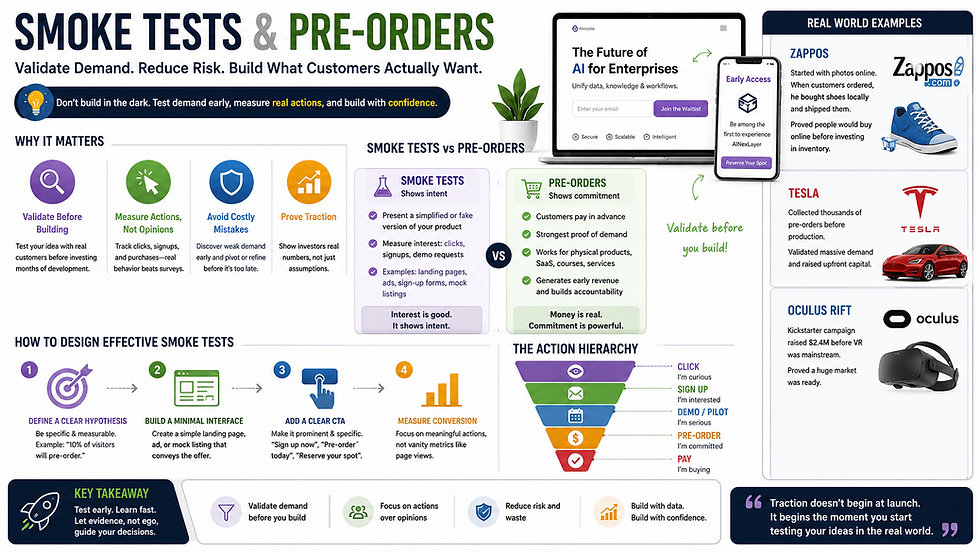
When I look at startup building, one principle has become increasingly important to me: I don't want to spend months building something only to discover that customers don't actually want it.
This is one of the biggest risks founders face.
We can have a strong idea, a talented engineering team, good technology and even funding. But none of those automatically prove that there is real demand.
For me, this is where smoke tests and pre-orders become extremely valuable.
A smoke test helps answer:
“Will people actually show interest in this?”
A pre-order takes the validation one step further:
“Are people willing to commit money to it?”
That difference is important.
At AINexLayer, I think about validation not as a one-time activity before building, but as part of the startup-building process itself.
Why Founders Should Validate Before Building
One of the easiest mistakes to make as a founder is falling in love with the product idea.
You imagine the architecture, features, dashboards, AI capabilities and future roadmap. Before you know it, months of engineering effort have gone into building something that has never been properly tested with the market.
The traditional approach is:
Idea → Build → Launch → Hope customers come
I believe a better approach is:
Idea → Hypothesis → Test → Learn → Build → Measure → Improve
This is especially important for startups operating in emerging technology categories such as AI.
AI makes it relatively easy to build impressive demonstrations. But the difficult question isn't always:
“Can we build it?”
The more important question is:
“Will someone use it, pay for it and continue using it?”
That's where smoke tests become powerful.
What Is a Smoke Test?
A smoke test is a simplified representation of a product or offering that allows you to measure customer interest before building the complete solution.
It could be:
A landing page
A product announcement
A pricing page
A signup form
A waitlist
An early-access campaign
A product mockup
A demo video
A campaign advertising a product that is still being developed
The objective isn't to pretend that the finished product already exists.
The objective is to measure real customer behavior.
Did someone click?
Did they register?
Did they request early access?
Did they schedule a demo?
Did they attempt to purchase?
These actions provide stronger evidence than simply asking someone:
“Would you use this product?”
Because there is a major difference between interest and action.
Behavior Is Stronger Than Opinions
Customer interviews and surveys are valuable.
But there is a limitation.
People often tell us what they think they will do.
Actual behavior can tell us something very different.
Someone might say:
“This is a great idea. I would definitely use it.”
But when presented with a signup button, they may do nothing.
Another person may not say much during an interview but immediately join the waitlist.
That second signal can be much more valuable.
This is why I like the principle:
Behavior beats talk.
For a startup, every meaningful customer action can become evidence.
Pre-Orders: The Strongest Demand Signal
Smoke tests measure interest and intent.
Pre-orders measure commitment.
When a customer is willing to put money down before the product is fully available, the signal becomes significantly stronger.
They aren't simply saying:
“This sounds interesting.”
They are effectively saying:
“I want this enough to commit to it.”
That can be extremely valuable for a startup.
Pre-orders can provide three important benefits:
1. Demand validation
You get evidence that customers actually want the solution.
2. Early revenue
Depending on the business model, pre-orders can provide capital that helps fund development.
3. Customer commitment
Paying customers create accountability. You now have a group of people who are expecting you to deliver.
For an early-stage founder, that can create a very different level of urgency and focus.
How I Would Design a Smoke Test
A smoke test doesn't need to be complicated.
I would start with four things.
1. Define the hypothesis
Don't start with:
“Let's see what happens.”
Start with something measurable.
For example:
“We believe 10% of qualified visitors will request early access to our AI platform.”
Now we know exactly what we're testing.
2. Build the smallest possible interface
You don't need the complete product.
You might only need:
A landing page
A short explanation
A product visualization
A demo video
Pricing or an early-access offer
A clear CTA
The objective is to communicate the value proposition—not to build the entire technology stack.
3. Create one clear call to action
Don't give visitors ten different options.
Ask them to do one thing:
Join the waitlist.
or
Request a demo.
or
Reserve early access.
or
Pre-order.
The simpler the action, the easier it becomes to interpret the results.
4. Measure conversion
Don't become obsessed with page views.
If 10,000 people visit your page but nobody signs up, that's not necessarily traction.
The important question is:
What percentage of qualified visitors took the action we wanted?
That is the signal that matters.
Applying This Thinking to AINexLayer
This way of thinking is particularly relevant to how I approach AINexLayer.
AINexLayer is designed as an enterprise AI platform, bringing AI capabilities into business workflows rather than treating AI as another isolated tool.
But even with a strong technical vision, I cannot assume that every enterprise has the same problem or wants the same solution.
Different organizations have different:
Data environments
AI maturity
Security requirements
Existing software
Workflows
Budgets
Decision-making processes
Integration requirements
So validation becomes extremely important.
Instead of asking:
“What features can we build?”
I would rather ask:
“Which enterprise problem is painful enough that a customer is willing to adopt and pay for our solution?”
That question changes the entire product-development process.
Smoke Testing an Enterprise AI Product
For an enterprise platform like AINexLayer, a smoke test could be much more focused than building the entire platform for every possible customer.
For example, suppose we identify a manufacturing use case around AI-powered analysis of operational data.
Instead of immediately building every possible manufacturing capability, we could create a focused proposition:
“Connect your operational data and ask questions about production performance using AI.”
Then we could test the response from a specific group of manufacturing companies.
We might measure:
Demo requests
Qualified leads
Pilot requests
Data connection requests
User registrations
Proof-of-concept commitments
Paid pilot interest
The objective is to discover whether the problem is strong enough to drive action.
From Interest to Intent to Commitment
I like to think about validation as a progression:
Click → Signup → Demo → Pilot → Payment
Each step represents a stronger signal.
A click means:
“I'm curious.”
A signup means:
“I'm interested.”
A demo request means:
“I want to understand this.”
A pilot means:
“I want to try this in my organization.”
Payment means:
“This problem is important enough for me to spend money solving it.”
The closer we get to payment, the stronger the evidence becomes.
Don't Build the Infrastructure Before Proving the Problem
This is particularly important for AI startups.
It is tempting to spend significant time building:
Complex AI pipelines
Agent architectures
Vector databases
RAG systems
Model orchestration
Analytics dashboards
Integrations
Automation workflows
All of these can be valuable.
But technology should follow validated demand.
A founder can build an incredibly sophisticated AI system and still have a weak business if customers don't care about the problem it solves.
The better sequence is:
Customer problem → Validation → MVP → Usage → Feedback → Product expansion
Not:
Technology → Features → More technology → Hope
What Zappos Teaches Us
One of the classic examples of this approach is Zappos.
The founder didn't begin by building a massive shoe inventory and sophisticated logistics infrastructure.
Instead, the initial idea was tested in a much simpler way.
Shoes were displayed online, and when customers ordered, the founder purchased the shoes from local stores and shipped them.
The operation wasn't scalable.
But that wasn't the point.
The question was:
“Will people actually buy shoes online?”
Once the answer became clear, the business could invest in building the infrastructure required for scale.
That's the essence of an MVP mindset.
Validate the business before optimizing the machinery.
Tesla and the Power of Pre-Orders
Tesla provides another interesting example.
Before mass production of its vehicles, customer pre-orders demonstrated that there was willingness to commit financially to the concept.
That creates a very different type of market signal.
Instead of saying:
“People seem interested in electric vehicles.”
You can point to:
“Customers are willing to put money down for this product.”
For founders, that distinction is incredibly powerful.
The Same Principle Applies to India
For Indian startups, I think this approach is particularly relevant.
India has a huge and diverse market, but that doesn't mean every customer segment is automatically ready for every product.
For example, an AI solution aimed at:
Manufacturing companies
Indian SMEs
Logistics operators
Healthcare organizations
Banks
Government departments
may face completely different buying processes and adoption barriers.
So instead of trying to target the entire Indian market from day one, a founder can test one narrow segment.
For example:
“Can we get 20 manufacturing companies in Telangana and Andhra Pradesh to request a pilot?”
That's a much more actionable experiment than:
“Is there demand for enterprise AI in India?”
The smaller question can eventually answer the larger one.
Smoke Test vs. Pre-Order
The two techniques are related, but they answer different questions.
Validation Method | What It Tests |
Landing page | Does the message attract attention? |
Signup | Is there meaningful interest? |
Demo request | Is there serious intent? |
Pilot request | Will customers try it? |
Pre-order | Will customers financially commit? |
Payment | Will customers actually buy? |
The goal isn't necessarily to jump directly to payment.
The goal is to identify the strongest evidence you can realistically obtain at your current stage.
The Founder Mindset
The biggest lesson I take from smoke tests and pre-orders is that founders should be willing to challenge their own assumptions.
We naturally want our ideas to succeed.
But the market doesn't care about our enthusiasm.
The market responds to value.
That's why I believe a failed experiment is not necessarily a failure.
If a smoke test shows weak demand, it may have just saved six months of development.
If a pre-order campaign doesn't convert, it may reveal that the pricing, positioning, audience or problem needs to change.
That is valuable information.
Build Less, Learn More
The objective of early-stage startup building shouldn't be to prove that we can build technology.
It should be to prove that the technology solves a problem people care about.
Smoke tests help us measure interest.
Waitlists help us capture early demand.
Pre-orders help us measure commitment.
And real customer behavior helps us make better decisions.
For me, the broader principle is simple:
Don't wait until after you build to discover whether customers care.
Test the market first.
Listen to what the data tells you.
Then build with confidence.
Because the smartest startup isn't necessarily the one that builds the fastest.
It's the one that learns the fastest—and invests only after the evidence is strong enough.
Try AINexLayer
If you want to explore how AI can help businesses work with their data, analytics, documents and workflows, you can try AINexLayer → app.ainexlayer.com.
The same principle applies here: start with a focused problem, understand the customer deeply, validate the value, and then expand from a strong foundation.
Start with evidence. Build with focus. Scale with vision.


Comments